
David Arnold proves his orchestral style fits James Bond like a glove with his score for Tomorrow Never Dies, an album that’s equal parts sultry and romantic as it is swaggering and action-focused, with the Bond theme happily featured extensively throughout. The ’90s-styled bombastic action is its highlight, as is the tremendous stylistic respect paid to John Barry!
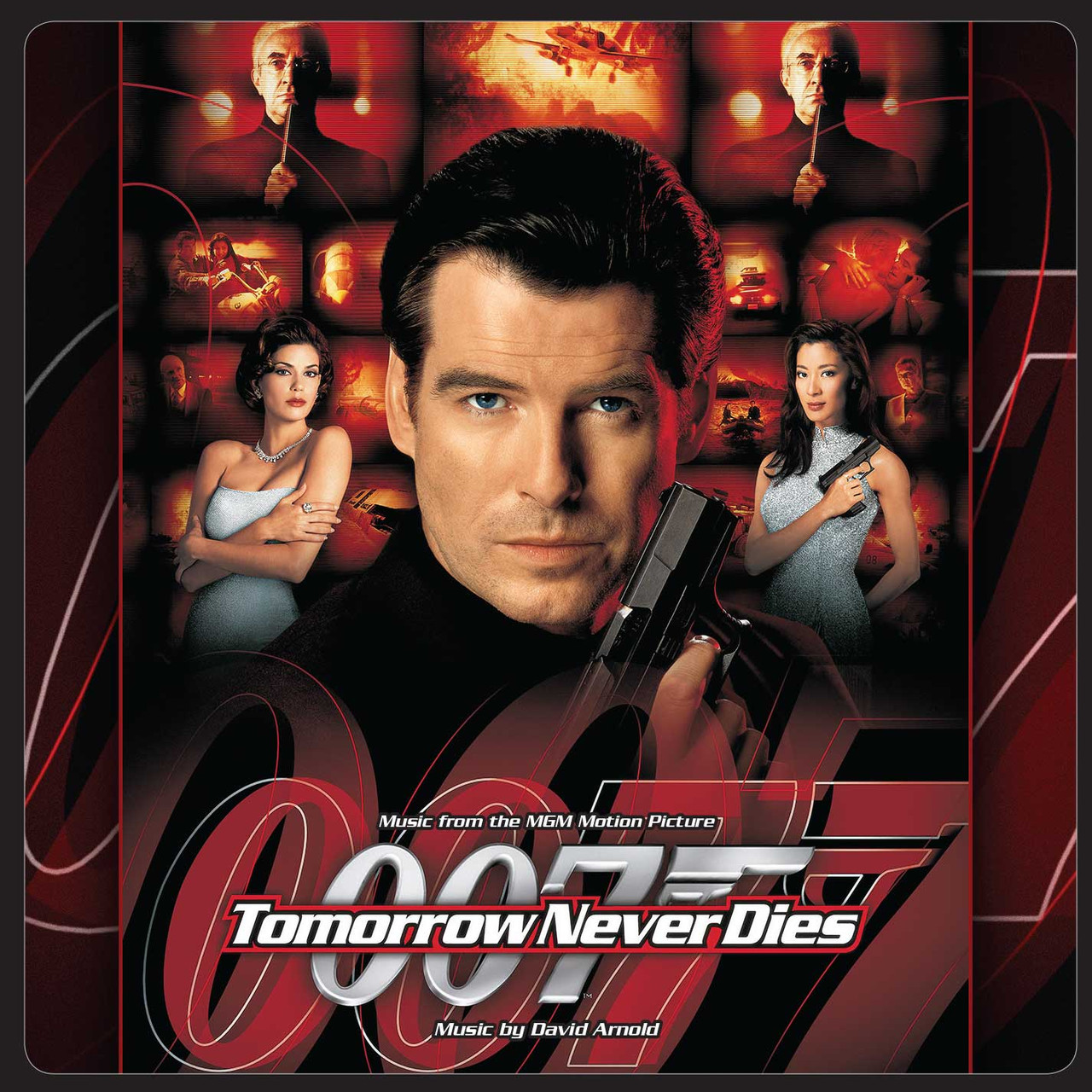
I think possibly my favourite era of James Bond film music is the David Arnold scores Pierce Brosnan era. There’s just something so wonderfully enthusiastic about the composer’s ’90s-styled music for that iteration of the character; the spellbindingly energetic uses of Monty Norman & John Barry’s Bond theme throughout the action cues, the sweeping romantic setpieces, the excellent intertwinings of the title song motifs – it’s all so well done, and the composer never shies away from giving Bond the triumphantly epic orchestral boost he needs either (something that’s sadly lacking in the modern day sound for 007, in my opinion). As a result, to this day The World Is Not Enough remains my favourite Bond score (for exactly the reasons described above) but a pretty close second is the one we’ll be talking about in this review; Tomorrow Never Dies, Arnold’s very first Bond score. For this 1997 film, the composer also co-wrote the song “Surrender” (which features in the end credits) sung by k.d. lang, and as is tradition, utilised the backing motifs of the song throughout the actual score. The result overall is a phenomenally stylish effort that pays many a loving tribute to John Barry – both in themes and brassy orchestral style – and it was made even better back in 2022, as La-La Land Records distributed a meticulously-crafted expansion and remastering of Arnold’s full soundtrack.
Said expansion begins with “White Knight”; the familiar suave notes of the Bond theme open this lengthy track in traditional gunbarrel style before much moodier strings, woodwinds and brass then start to echo a troubled ambience. Some rather spy-like hits of percussion then join the fray, seeming to sound out the opening notes of Tina Turner’s title song for Goldeneye – though this could just be coincidence – with the wary orchestral ensemble then lying in quietly low-pitched wait until the three minute mark, where the action begins! Marching drums and increasingly tense bursts of strings and brass kick things off, with the orchestra overall swirling in desperately dramatic despair until triumphant brass finally surges to the forefront at just past four minutes. Hints toward the Bond theme echo confidently on strings from here, with references to John Barry’s From Russia With Love serving as the ‘action motif’ until “Surrender” suddenly leaps into centre stage to now command the increasingly frenetic music. The Bond theme too also returns, joining forces with “Surrender” to deliver powerful brassy blows to the rising drama all the way up to a deafening final crescendo. The two minute “Backseat Pilot” then continues immediately where it leaves off, with a briefly victorious Bond theme soaring before danger quickly re-engulfs it. This doesn’t last though, as confidence quickly returns to the motif after a minute or so of orchestral wrestling, leading directly into the film’s title song.
“Tomorrow Never Dies” by Sheryl Crow isn’t a bad song by any means – I actually quite like it – but I’d be lying if I said it holds a candle to k.d. lang’s “Surrender” (which as mentioned, is sadly relegated to just the end credits). After the emphatic Crow song fades out it’s then followed by “The Sinking Of The Devonshire”, which opens in a quiet and rather restrained manner with shrill strings echoing against militaristic percussion. It isn’t long though before tensions rise again, as anxious brass and strings run worriedly along until a decidedly malevolent burst of brass at 03:56 signifies the arrival of the film’s surprisingly modernised (for the time anyway) villain, Elliot Carver. With the titular sinking dealt, sorrowful vocals and orchestra then occupy the latter half of the seven minute track. The classic Barry-styled guitar then swaggers the Bond theme back into view for “MI6/Launch The Fleet”, with the subsequent “Company Car” continuing this orchestral and thematic enthusiasm for three and a half delightfully upbeat minutes with the “Surrender” motif also proudly centre stage. Frantic action then occupies the first half of “Station Break” with wild bursts of sublimely orchestrated brass in the lead, before the music settles in the back half to introduce a gentle new six note motif (to be fully realised later on). A tremendous romantic flourish is then the focus of the sadly short “Paris And Bond”, with some utterly gorgeous strings and piano playing centrally throughout until simply fading to a gentle close.
The gentle love theme reprises on wistful woodwinds and plucked strings through “The Last Goodbye”, before the music then shifts into stealth mode for the ominous “Hamburg Break In”. Barry-styled, spy-like stabs of brass are entertainingly central here, with the Bond theme also swaggering back into view alongside moody electronics. The pace then kicks up quite substantially for action duo “Hamburg Break Out” and “Printing Press Fight”, as references to “Surrender” surge atop rapid ’60s-style brass and drums through both ninety second cues, before “Escape To Hotel” caps off the action segment with a tremendously victorious orchestral playthrough of both the Bond and From Russia With Love themes. The love theme then returns for “Doctor Kaufman”, though this time in an almost sinister manner as foreboding strings simmer underneath the usually gentle notes, before the score and Bond theme start to regain confidence in the subsequent “*-3-Send”. This then leads pretty seamlessly into “Backseat Driver”, four and a half minute action setpiece and the score’s standout moment; a rapid electronic beat kicks off this mind-blowing track, with the Bond theme quickly rising in brassy grandeur alongside the “Surrender” motif. The orchestral ensemble then builds with ferocious intensity for the next few minutes, getting louder and more boisterous until a final crescendo is reached and the Bond theme utterly soars for its most breathtakingly triumphant rendition yet. Absolute. Goosebumps.
Bond strides with militaristic prowess in “Okinawa/HALO Jump” as marching drums take point, before the score then turns dark and rather eerie for the first half of “Underwater Discovery”. Increasingly anxious strings and brass however then rapidly overtake in the second, building to a tense crescendo. The six note motif from earlier – now revealed as a theme for Wai Lin, Michelle Yeoh’s character – returns in the reserved “Vietnam” on quiet guitar and electronics before action then surges back to the forefront in the lengthy “Bike Chase”, and much like “Backseat Driver” – this one’s a winner too. Loud brassy references to Barry’s suave Bond sound are all abound here, married perfectly with Arnold’s frenetically ’90s action style with both the Bond and “Surrender” themes intertwining boisterously throughout, resulting in a seven minute action setpiece that is simply, utterly spectacular – the phrase ‘why doesn’t Bond sound like this any more‘ once again echoes in my mind. A moody electric guitar then simmers with Wai Lin’s theme in “Bike Shop Fight”, with light percussion evoking serene ambience alongside said theme and tranquil string plucks through “Ha Long Bay” afterward. Tensions then start to pick up again in “Boarding The Stealth”, as anxious interspersions of the Bond theme dart inbetween wary strings and drums, with the subsequent “Grenade” also continuing in much the same stylistic vein.
With the finale of the score approaching, “A Tricky Spot For 007” opens quietly before slowly building into emphatic action, with the From Russia With Love motif once again reprising alongside the Bond theme on grandiose brass and marching drums. Hints toward Wai Lin’s theme then fade the track to a close, with “Stealth Shoot Out” afterward continuing rising tensions until a swaggering and enjoyably full rendition of the Bond theme strides in at the two minute mark. Carver’s malevolent material then goes head to head with Bond in the three minute “Carver Gets It”, exchanging orchestral blows throughout the track’s runtime until a decidedly deafening crescendo is finally reached. The lengthy “All In A Day’s Work” then picks up right where the battle leaves off, with frenetic brassy action leaping along until the Bond theme at last emerges victorious with a tremendously Barry-styled rendition. From here the theme continues to swagger until Wai Lin’s motif also receives a fantastically victorious playthrough on soaring orchestra, with the music then settling into quiet romance on strings to bring the story to a close. To wrap up the score proper, k.d. lang’s phenomenal “Surrender” then grandly blasts into centre stage and simply doesn’t let up for four sublime minutes. What a song!
Overall, David Arnold’s Tomorrow Never Dies is such an amazing James Bond score, especially considering that it was the composer’s very first one. The orchestral style is a perfect marriage of sultry 60’s-styled John Barry-isms with bombastically ’90s-sounding Arnold action flair, and the result is genuinely spellbinding. The album grabs your attention right off the bat with the impeccable “White Knight” and simply never lets go, with further action cues like “Bike Chase”, “All In A Day’s Work” and the standout “Backseat Driver” all showcasing just how well Arnold’s compositional style works for Bond. He has a clear love of the source material as well, as there are not only the aforementioned Barry-isms absolutely everywhere, the Bond theme also features substantially throughout the score (as it should) alongside the action motif from Barry’s From Russia With Love. Speaking of themes, joining them is also the sublime backing motif from k.d. lang’s “Surrender” (co-written by Arnold) as well as new ones in a dramatic theme for Wai Lin (“All In A Day’s Work”), a gorgeously romantic love theme for Bond and Paris Carver (“Paris And Bond”), and a malevolent lurker of a motif for villain Elliot Carver too (“The Sinking Of The Devonshire”). All these themes fit together seamlessly for a damned entertaining Bond score overall, and while I do personally prefer the over-the-top orchestral/electronic swagger of The World Is Not Enough as my favourite Bond score, there’s no denying that Tomorrow Never Dies is easily second place. An absolutely phenomenal effort by Arnold!
Score: 8.5/10
Standout Cues: White Knight, Company Car, Backseat Driver, Bike Chase
Buy the 2-CD expansion for David Arnold’s Tomorrow Never Dies here, by La-La Land Records.

Follow me on Twitter for the latest soundtrack and review-based news!

Leave a Reply