
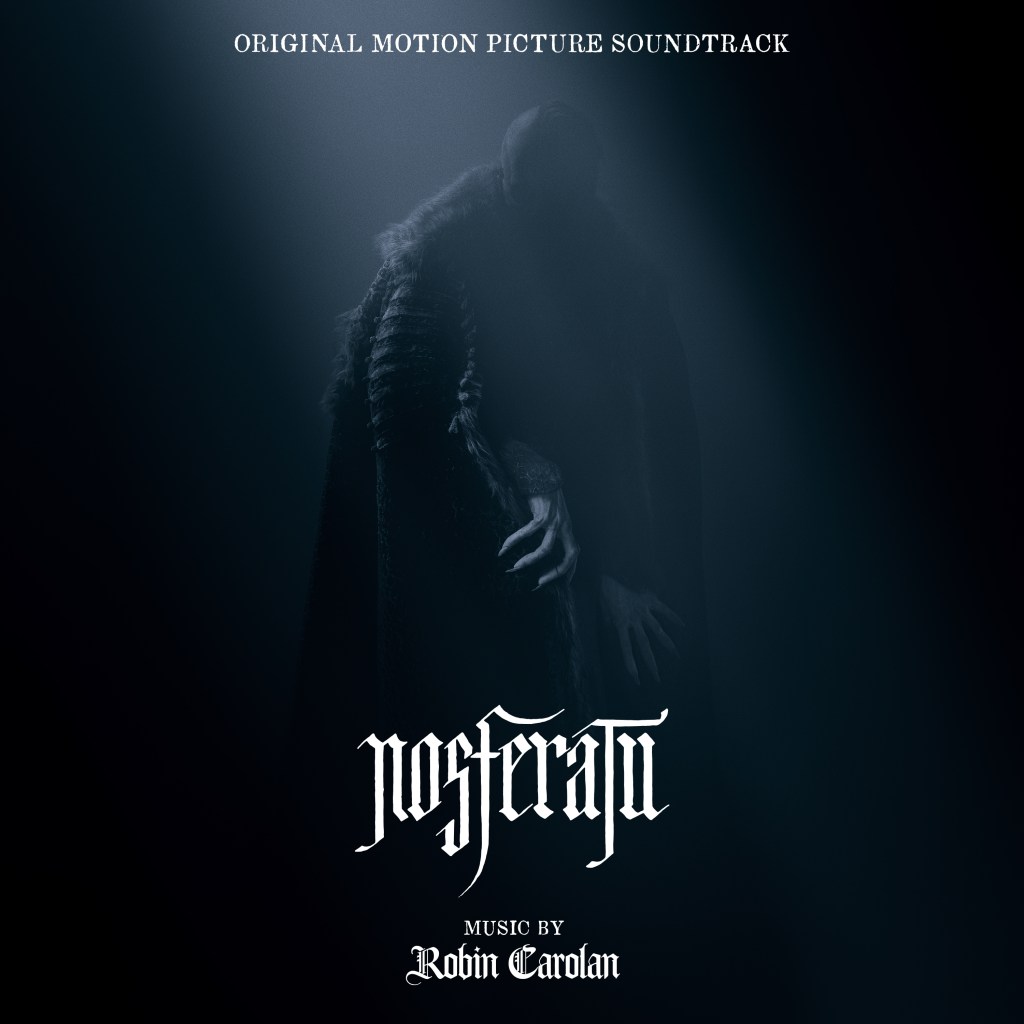
Enter a world of haunting gothic grandeur with Robin Carolan’s Nosferatu; while the dissonance of its more horror-like aspects and moody, ominous ambience does make it a tough listen at times, the utterly beautiful serenity of the more darkly, twisted romantic side to it – with “Daybreak” as its gorgeously devastating centrepiece – makes this score more than worth a listen.
“Once Upon A Time” introduces us to Robin Carolan’s Nosferatu with the gentle yet eerie plinking of music box notes. Pretty much immediately nowadays to be honest, as soon as I hear a music box the hair on the back of my neck starts to stand on end as horror scores of many fares – A Nightmare On Elm Street, Five Nights At Freddy’s, Hellraiser – have now twisted and distorted that once innocent and child-like musical instrument to terrifying new effect. And it’s no less eerie and hair-raising here with Nosferatu, with Carolan having pretty much immediately set a moody and malevolently horrifying tone right off the bat as a result. The subsequent “Come To Me” then starts to dive more into Carolan’s compositional style for the movie, with a darkly gothic strings-focus that haunts as much as it terrifies, alongside increasingly jumpscare-esque vocals and brass crescendoing alongside said strings for much of the track. “Premonition” then introduces the first of the composer’s themes for the film, an eerie repeating two-note motif on sinister strings, representing perhaps the mystery and temptation of Count Orlok given how it moodily and malevolently plays in its ninety second debut cue here. “Ellen’s Dream” then alleviates the tension somewhat initially with quieter, gentler strings before a sinister darkness starts to almost pour itself back into the music for a dramatically enveloping crescendo. “Goodbye” opens initially with the ominous two-note motif for Orlok before louder, hopeful and yet serene strings then quickly debut a swirling, rather wondrous piece presumably for Ellen and Thomas Hutter, the main human characters of the film.
The sub-minute “Foreign Land” shrouds itself in haunting darkness and mystery with moody strings at its forefront, with the three minute “The Inn/Moroi” continuing in much a similar vein with the addition of sinister low-pitched brass and two thunderously hair-raising crescendos. Coldly echoing vocals and dramatic crashes of percussion then practically shake the floorboards in “A Carriage Awaits”, with increasingly unnerving strings emphasizing this right up until cue’s end. A series of dissonant, ghostly atmospheric setpieces then follow, starting at “Come By The Fire” and ending at the end of “The Crypt” as eerie strings and echoing vocals give way to a sheer almighty crash of terrifying high-pitched strings. “Lost” and “Wolves At The Door” then utilise said strings to horrifying effect as tense action segments, with “Hysterical Spell” slowing things back down as the moodily malevolent two-note motif for Orlok’s mystery reprises on eerie strings. The subsequent “Devourance” then relies on hair-raising string plucks to induce wary ambience for much of its four minute runtime until coldly sinister vocals then introduce another brand new theme, this time a four-note piece again for Orlok, this time however for his malevolence and evil actions – presumably anyway, given how tensely this theme is then used through the rest of the score. It plays loudly and terrifyingly here with the vocals rising to deafening levels alongside frantic strings before the track then fades to a worrisome close.
Hair-raising vocals and horror-like strings are the focal point of minute-long “The Monastery”, with “Increase Thy Thunders” then reprising the frightening four-note motif for the malevolence of Count Orlok on grandly gothic strings ever-increasing in both volume and intensity alongside crashes of percussion and emphatically chanting vocals. Gentle strings-based serenity however then occupies “The Professor”, with a quiet almost romanticism occupying the instrumentation throughout the track’s two minute runtime. This doesn’t last for long though as the subsequent “Departure” then briefly reprises the mysterious two-note Orlok motif, “Dreams Grow Darker” however a couple tracks later then starts to fall back into the gentle gothic string ‘romance’, this time with an almost ethereal serenity to it. Eerie atmosphere then occupies the next few tracks until the end of “An Arrival”, where the four-note malevolence motif for Orlok reprises on now boldly villainous brass and strings, building to a dramatic crescendo by cue’s end. An eerie high pitch is then the tonal focus of “A Return”, with additional, more withdrawn strings playing alongside backing swells of drums and brass rising emphatically. The four-note malevolence motif for Orlok then returns in grandly gothic form in the very short “Grünewald”, with a loudly horror-like strings crescendo being reached in the subsequent “Despair In My Coming” and sinister ambience set in “A Curious Mark” before said four-note motif then reprises in thunderously villainous form on eerie vocals, crashing brass and terrifying strings in “Orloks Shadow”.
The now fully established twisted romanticism of earlier cues returns in “The Vampyr”, with haunting strings and worrisome plucks seeding a particularly unnerving tone throughout while playing an unusually serene rendition of the four-note Orlok malevolence motif. Five minute atmospheric setpiece “The First Night” then opens coldly, with moody strings and haunting vocals then introducing another brand new theme – the ‘Night’ motif I’m going to call this one, given its later appearances and generally serene yet ominous nature – which takes haunting focus for much of the first few minutes of the track before the tone slowly starts to turn villainous as the four-note Orlok motif practically bleeds into view. A burst of jumpscare-esque vocals then announces the full arrival of the malevolent theme with a chanting chorus, sinister strings and bursts of tense brass crescendoing the track out a short while later. In the fading aftermath of the ‘night’, “Death All Around Us” returns to the more sorrowful side of the score with downtrodden strings, though the eerie two-note motif for Orlok’s mystery does reprise in the back half. Loudly jumpscare-esque string ambience then occupies much of the five minute “I Know Him” before “The Second Night” lurks coldly in the shadows with low-pitched instrumentation and a cold, moody tone. The two-note mystery motif reprises in coldly wary style in “These Nightmares Exist” alongside tense string plucks before continuing straight into “A Priestess Of Isis” in slightly more hopeful, romantic form.
Gently wistful woodwinds are the focus of the minute long “Last Goodbye”, with similarly pensive and thoughtful strings then occupying the subsequent “Never Sleep Again”, leaving an almost tragic feel in their wake. Tense action then arrives to usher in the finale of the score in “The Third Night” with frenetically chanting vocals in centre stage, before sheer strings-based horror descends throughout “The Prince Of Rats”. Tragedy then starts to envelop the music once again for “Her Will”, setting the stage for a tremendous emotional culmination in “Daybreak”, an eight minute dramatic setpiece and Standout Cue of the score. The cue opens pensively, with eerie strings threatening the presence of Orlok alongside the moodily enveloping “The First Night” material from earlier. This motif then starts to slowly build over the course of the first half, rising in volume, intensity, tragedy and sheer grandiosity as the full orchestra builds behind it. A colossal emotional crescendo then practically erupts at the four minute mark, bringing the theme to a devastating climax for the most beautifully serene orchestral moment of the entire album. One further, more ominous crescendo then builds after it before the music then simmers to a gently sorrowful close. Final cues “Liliacs” and “Bound” then bring the score overall to its finish, with the former reprising the two-note mystery motif once last eerie time along with a final solemn statement of the Hutters theme, and the latter reprising the ‘Night’ and “Daybreak” material for one last utterly devastating crescendo.
Overall, Robin Carolan’s score for Robert Eggers’ new Nosferatu is as beautiful as it is tragic, and the sheer orchestral elegance that’s displayed across many of the fifty one tracks here – but particularly in the finale – makes it well worth a listen. The main tonal and stylistic focal point is this kind of eerie, gothic romanticism and the utilisation of these utterly gorgeous strings as its haunting method of instrumental delivery, and this expertly unnerving style combined with several recognisable motifs all-in simply fits Nosferatu like a glove. Speaking of motifs, the most prevalent of Carolan’s themes here are the Orlok ones – an ominous two-note piece likely representing the mystery of the Count (see “Premonition”), and a louder and much more dramatic five-note one for whenever the titular vampyr strikes (see “Orloks Shadow”), but the most beautiful are the ones for the human characters; the gently mournful piece for the Hutters that plays across “Goodbye” for example is brilliantly serene, and the way it then builds to an absolutely devastating conclusion in “Liliacs” as part of the finale is orchestral storytelling at its finest. It’s the “Daybreak” motif though that’s the absolute star of the show here, as the tremendous emotional swells it goes through across the aforementioned cue and the conclusive “Bound” are just utterly gorgeous in their haunting strings serenity, and all-in if it wasn’t for the dissonant horror action fare and moody ambience you do have to sort of slog through in this album at times to get to the moments of sheer beauty like the above, this score’d be close to impeccable.
Just hit play on “Daybreak” below. Haunting yet utterly beautiful.
Score: 7.5/10
Standout Cues: Daybreak/Liliacs/Bound

Follow me on Twitter for the latest soundtrack and review-based news!



 Zanobard Reviews
Leave a reply to SVB Cancel reply