
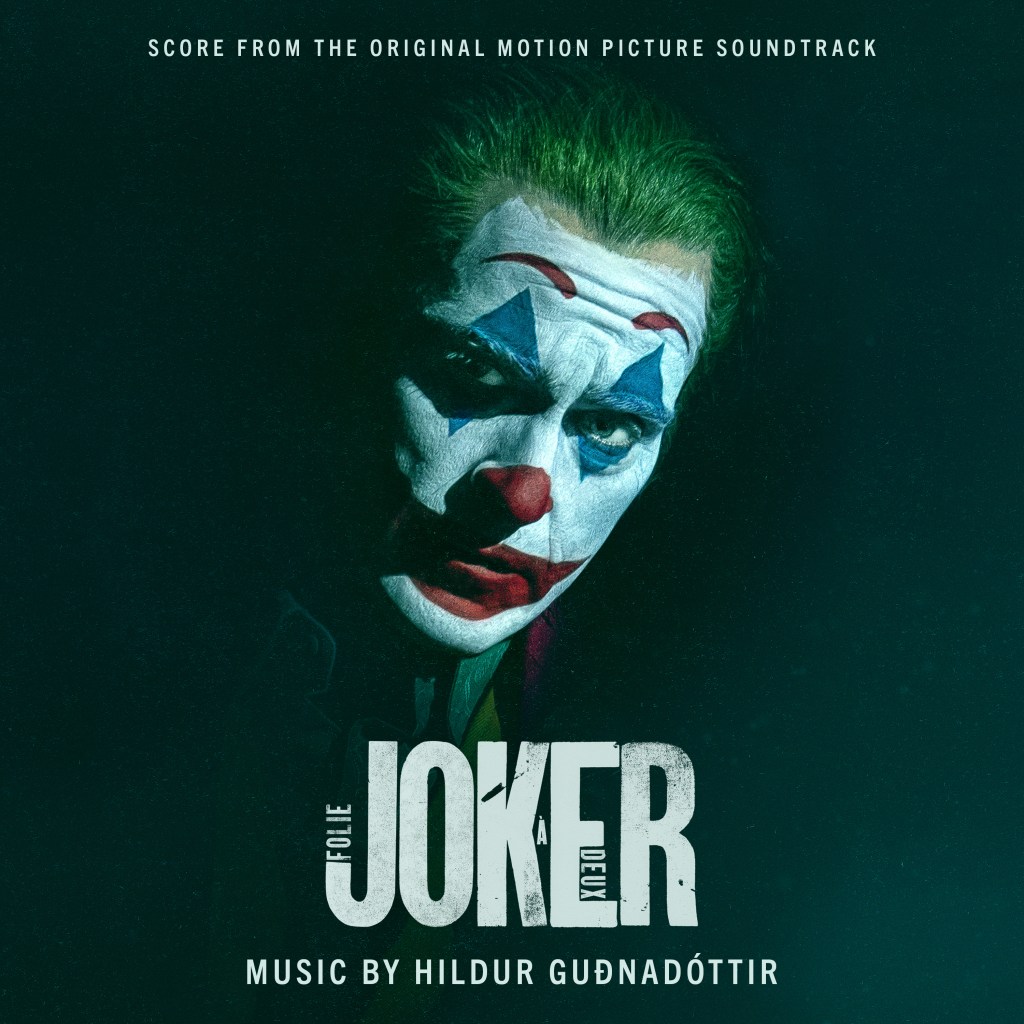
Hildur Guðnadóttir’s hauntingly ambient score for Joker: Folie à Deux takes an expectedly similar approach to the first film’s, with the moody cello once again taking stylistic prominence alongside the returning ‘descent-into-darkness’ main theme, which I’m sure all fits the film perfectly… but as a standalone album experience, it’s still just not all that interesting.
Guðnadóttir’s score for the first Joker film was a little controversial when it came out, at least among the film music crowd. Some loved it, some certainly didn’t, but from my side personally I felt the composer had absolutely nailed the moody, suspenseful tone of the film and the ‘descent into darkness’ aspect in particular that Arthur Fleck goes through, and the music works very well within the movie as a result – but as a standalone listen… I found it lacking. Mainly because much of the album just consisted of meandering, atmospheric string textures that don’t really interest or intrigue when listened to on their own, with the slight exception being the cello-based theme for the Joker himself. As such, it was with… hesitation I must admit that I approached this sequel score for Folie à Deux; I dived in expecting little more than what we received on the first film’s score, and now I can confirm – that’s exactly what we get.
Opening track “It’s Showtime” reels us back into the eerily unnerving musical world of Guðnadóttir’s Joker right off the bat, with the composer’s solemn Joker motif reprising on a quietly pensive cello alongside echoingly tense percussive notes that sound almost like a ticking clock. The volume then picks up in the back half of the cue, hammering home the moody intensity of the sinister theme before the track then fades to a gentle close. Lingering cello notes then take the forefront in “That Dumb Laugh”, a cue that establishes pensive ambience throughout its runtime with motivic hints toward the overarching Joker theme. This quiet atmosphere then continues into the subsequent “Same Ol’ Joker”, with the main theme playing in more withdrawn and insular form and sinister high-pitched strings accompanying in the back half. A slight tonal elevation is then heard in “The Real You” with brief hints toward hope emerging alongside the Joker motif on cello, playing gently until fading out at two and a half minutes long.
Hints toward malevolence moodily raise their heads in the minute long “Back On TV”, with quiet surges of strings elevating the tension until “Buy Me A Drink First?” brings this to a head with percussion increasing in both volume and intensity until a dramatically deafening finishing crescendo is finally reached. Strings then become insular and thoughtful again in the slightly lighter “Trial Of The Century”, though additional ones then fade into centre stage in the back half playing in almost lament style. The Joker theme then returns in “My Mother Had Me Committed”, this time in stronger and almost confident form, but this doesn’t last for long before “The Saints” dials up the tension considerably as loud, horror-like strings build to a rapid crescendo to open before the track descends into moody malevolence for its final minute. Eeriness is then the tonal focus of the first thirty seconds or so of “The Other Half” before a sudden burst of louder strings emerges and the moody rapidly turns moody and sinister.
Quietly eerie ambience overtakes in “Social Services”, with ominously pulsing instrumentation pulling focus until the track builds to a louder, more imposing finish. The cello is then back in full force in “Knock Knock” in as moodily haunting a tone as ever before things get rather sinister in the back half with much lower-pitched notes playing the main Joker theme. This whispering creepiness then continues into “Doppelganger” with quietly ominous strings fading in and out, getting louder and more intense with each further fade until finally fading away for good at just over two minutes in. “That’s All Folks” then simmers even further down into moodiness with increasingly tense percussive pulses, and “Old Neighbourhood” reprises both the cello and Joker motif as the former plays the latter in sinisterly morose style alongside additional higher-pitched backing strings. Frenetic percussion and stabbing strings then rapidly overtake in “Uh Oh, I’m In Trouble” as tense action takes the stylistic stage, with all the aforementioned instrumentation then building a dramatically deafening crescendo.
With the soundtrack now starting to approach its end, “Voices” quietens down the dramatic nature of the previous cue with gently downtrodden and almost sorrowful strings hinting toward the Joker theme. Said motif starts to re-emerge in confidence somewhat for subsequent cue “There Is No Joker” however, with the theme playing quietly initially before gradually getting louder approaching the track’s midpoint, and then simmering quietly back down to end the piece. Final track “It’s All Theater” then opens ominously, with rising and falling surges of strings playing in an almost horror-like, high-pitched fashion. The music then starts to get a little brighter at just past the halfway mark with additional strings and the main Joker theme joining the fray, until all the instrumentation then dramatically crescendos in a boldly grandiose manner much akin to that of final cue “Call Me Joker” from the first film – thus closing the score.
Overall, I honestly don’t have a huge amount to remark for Hildur Guðnadóttir’s Joker: Folie à Deux score. Much like with the first film the cello is the stylistic centrepiece of the composer’s work here, playing in as moodily malevolent fashion as ever to represent the growing darkness of titular character Arthur Fleck. The character’s main motif from the first score too returns, establishing its haunting self almost immediately in opening cue “It’s Showtime” before moving dramatically across the album with the cello tensely following. That’s the main point of interest for this score for me personally, the eerie main theme, but even then all-in honestly with this sequel soundtrack my feeling remains much the same as with the first one – it’s a hauntingly atmospheric and well crafted piece of musical work from Guðnadóttir overall and I’m sure it works splendidly in the new film, but on album it’s just… not very interesting to listen to, at least for me. There’s little substance even including the main theme, it’s mostly just more quietly strings-based ominously ambient soundscaping like the first film’s. And as a result I just don’t really enjoy it.
No doubt some will love Folie à Deux‘s similarly dour musical approach to the Joker – especially if they loved the first score – and fair play to them if they do. But for me – sorry, I still find it lacking.
Score: 6/10
Standout Cue: 1. It’s Showtime

Follow me on Twitter for the latest soundtrack and review-based news!



 Zanobard Reviews
Leave a comment