
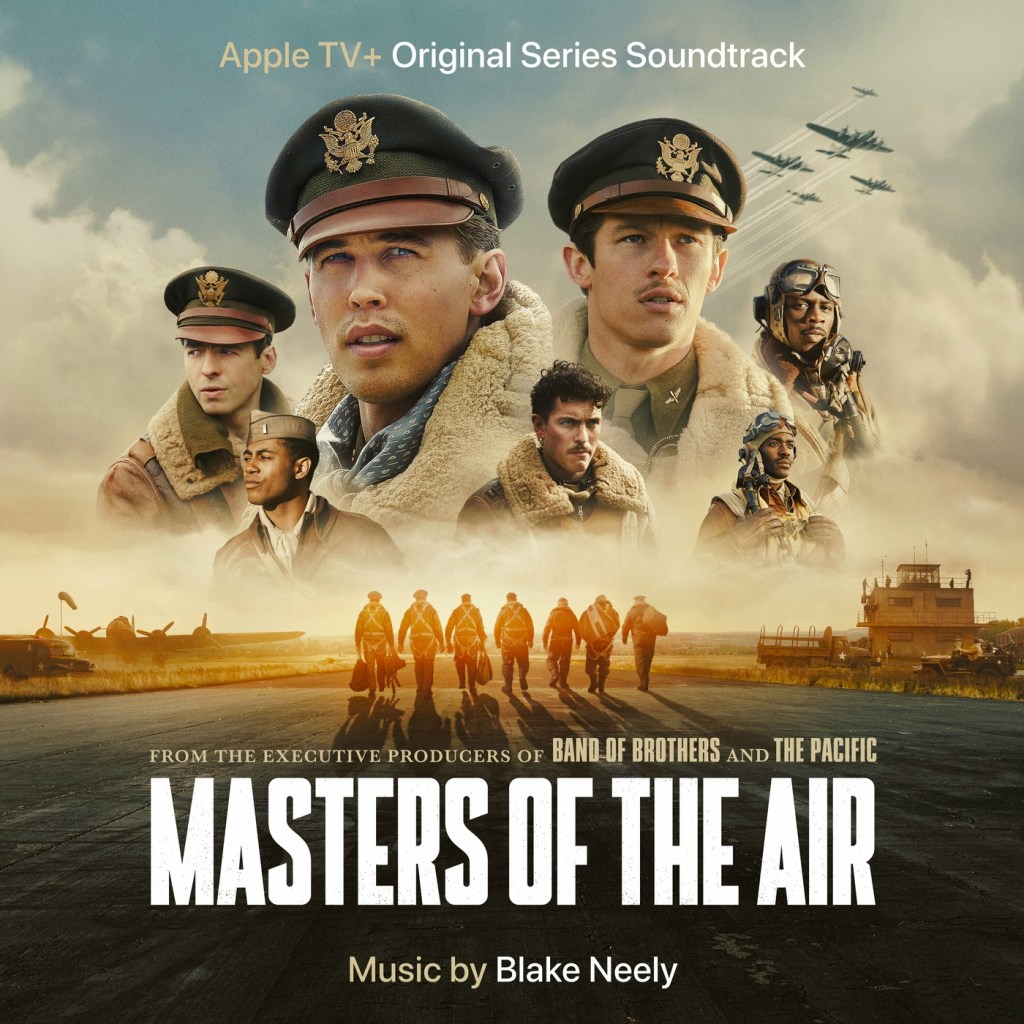
Blake Neely’s Masters Of The Air is pretty stellar; much like his work for The Pacific and Greyhound it achieves a near perfect tonal and orchestral balance of bold heroism and quiet solemnity that, bound together with a rather memorable main theme in “Soar”, altogether makes for a well made and indeed solidly entertaining war score.
I do like a good Blake Neely war score. The composer actually worked on the previous HBO war miniseries The Pacific (from 2010) – which like Masters Of The Air was also produced by Tom Hanks and Steven Spielberg – alongside composers Hans Zimmer and Geoff Zanelli, and the music they composed for that series was pretty astounding as it tonally captured not only the raw heroism of those who fought for the Allies in World War II, but also the terrible horror of the fighting involved. A solemn yet perfectly balanced tonal mixture of heroic and soulful, which was also pretty perfectly represented in Neely’s film score for Greyhound, a Tom Hanks’ starring WWII picture from 2020 depicting an Allied naval convoy’s struggle for survival during the Battle of the Atlantic. You can find my full review for that particular soundtrack here, but in summary it is equal parts tense and harrowing as it is gentle and hopeful, with standout cue “But At What Cost” still being one of my favourite pieces of film music around because of how brilliantly it captures that. In summary then, given the composer’s prior excellence in this war-based filmic arena, to say that my anticipation for new miniseries Masters Of The Air was high after learning that Neely would score it, is an understatement indeed. And now after a long wait – both for the music and the series itself in my case – it’s finally here, and slight spoilers for the review ahead – the composer has certainly not disappointed, so let’s dive straight in.
Opening track “Soar (Main Title)” introduces the main theme for Masters Of The Air, and if there’s one thing I simply must say about it, it’s that it certainly lives up to its title. The track starts quietly with gently hopeful strings and solemn brass, before the orchestra then builds dramatically to crescendo and the music then simply and utterly soars. Tonally, Neely has once again expertly captured that heroic yet soulful feeling that works so well for his war scores, yet it has more of an… elegance to it with this theme; a solemn beauty in the style of the music here that really evokes flying, and for two and a half utterly fantastic minutes here that’s exactly what this opening track does, and it’s simply spellbinding for it. Now, before I get too ahead of myself I will say that of the themes for each of the three Hanks/Spielberg miniseries so far – Band Of Brothers, The Pacific and this – in terms of sheer memorability Masters Of The Air‘s is perhaps the weakest, just because the actual notes of its main theme aren’t quite as instantly memorable as the other two’s – it does take a few listens to really catch the theme here. But for me personally that doesn’t matter too much, as in terms of the sheer emotion that Neely’s main theme here delivers it is pretty spectacular, and all-in is best described I think not as the worst of the three themes, but simply the least best, as it’s still pretty damned brilliant, and stands high as yet another excellent piece of music representing that era of history.
With the main theme introduced, “Post Engines, Pre-Flight” features nervous optimism as its tonal focus, with wary strings and noble brass notes in centre stage through much of its four minute runtime until a dramatic finishing crescendo is reached. “Around The Clock” then gives us our first taste of action, with tense strings opening the six minute track alongside what sounds like an actual ticking clock. Tensions mount with solemn notes from the main theme reprising through much of the first half, before the pace then quickens and the volume rises in the back half with worrisome bursts of brass then delivering a frenetic finish. Things then slow down substantially for the subsequent “Every Second Is A Little Death”, with downtrodden strings and low-pitched brass evoking a keen sense of sorrow throughout. Action pair “I Can Fix It” and “Rack ‘Em Up And Knock ‘Em Down” however then rapidly dial the tension back up, with the former cue making dramatic use of frenetic strings until the main theme then soars into heroic view in its back half on brass, and the latter cue bringing back the ticking clock for further minutes of nail-biting musical stress until a crashingly brass-heavy crescendo closes out the musical thunder. Action cue “The Bloody Hundredth” is then the best of the action bunch, featuring emphatic orchestral build-up for the first two minutes before the main theme then practically charges heroically into the fray in what is one of its finest renditions on the album.
Seven minute action setpiece “The Enemy Below” is high on the tension scale, with frantically-paced strings opening the dramatic cue alongside bursts of worried brass. Thunderous drums then accompany this orchestral strain for much of the track’s runtime with the main theme surprisingly absent, until the music then strikingly crashes out. Brassy hints toward the main theme then begin to play through the first half of “Punching Through”, before a full rendition then brightly reprises on hopeful strings and militaristic brass to close out the track. Strings-based solemnity is then the focus of “Stories Over Poker”, with the volume dialed gently down for much of its five minute runtime. This quietness doesn’t last for long though, as tension starts to build again on moody strings through “An Impossible Ask” with the occasional hint towards the main theme until sorrowful vocals bring it to a close. The aforementioned tension then continues to build in “Unchosen Transfers”, a five minute motif-less action setpiece that focuses heavily on low-pitched, ominous brass, frantic strings and dramatic drums before solemn pair “Long Winter March” and “Horrors” then slow down the pace considerably as intense orchestral sorrow overtakes the music.
An intensely patriotic variation of the main theme plays at the start of “The Flag”, with uplifting brass and strings accompanied by crashes of percussion taking centre stage. This orchestral optimism then continues into the subsequent “Surrender” and “Celebrations” cues, with both utilising gently hopeful instrumentation for much of their runtime until the latter track loudly crescendos out. Melancholic brass then opens “This Is It”, before more optimistic strings enter the fray at the ninety second mark and the full orchestra builds and plays rousingly for much of the emphatic track’s remaining two minutes. To close out the album, “Going Home” – which also serves as the end title piece for the show – then reprises that heroic yet soulful orchestral style that the composer has absolutely nailed down at this point, with the music starting quietly and slowly before then building into almost triumphant heroism at the halfway point, and then simmering back down as the cue approaches its end to then end the score on a quietly thoughtful note. A perfect ending.
Overall, Blake Neely’s Masters Of The Air is a pretty damned solid war score, being equal parts grand and rousing as it is quiet and solemn, and featuring a rather well-crafted main theme too. And speaking of, the aforementioned motif featured through Standout Cue “Soar” does just that really, flying high and proudly as it breathtakingly establishes itself as Neely’s main title for the series on heroic brass and soulful strings. While the motif itself is perhaps less memorable than the other Spielberg/Hanks World War II series’ Band Of Brothers and The Pacific, I’d certainly describe it as ‘least best’ rather than ‘worst’, as it’s still a pretty stellar theme in its own right and is very fitting for the series in both its solemn yet hopeful tone and grand orchestral style. The motif is then of course featured across the album, with notable appearances being in thunderous action setpiece “The Bloody Hundredth” and the more solemn “Around The Clock”. And outside of the main theme too the score has yet more to offer, the grandly powerful “Post Engines, Pre-Flight” for example is pretty fantastic, as is the more melancholic but still quietly hopeful end title piece “Going Home”. So all-in, there’s a lot to like with Neely’s music here, and honestly if you liked The Pacific or the more optimistic side of the composer’s Greyhound work, you’ll probably really enjoy this too.
Score: 7.5/10
Standout Cues: 1. Soar (Main Title)/8. The Bloody Hundredth

Follow me on Twitter for the latest soundtrack and review-based news!


 Zanobard Reviews
Leave a comment